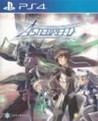
One of the best, most underrated indie games out there, made doubly impressive by the development company's obscurity & status as part-timeOne of the best, most underrated indie games out there, made doubly impressive by the development company's obscurity & status as part-time devs and sadly held back by various public misconceptions, the primary one being that it is a "bullet hell game" and thus "doing it wrong". Despite classic arcade-like design principles, it's not a "nostalgia game"; it can hardly be described as "X meets Y". Maybe Sin & Punishment's cinematic on-rails presentation + a shmup's bullet dodging + Alien Soldier's sheer variety of stuff to do... but that wouldn't really do it justice.
As I said, it's not a bullet-hell; I'd even have trouble calling it a shmup. It's more of an... anime mecha game. You control a robot while locking-on, shooting, sword-slashing and comboing your way through various perspective-shifting stages. You have two normal shots (activated by tapping their respective buttons) & two lock-ons (holding down their respective button). The lock-ons are a forward & spread shot respectively, either targeting around you in a circle or in a straight line. Your slash is more than it seems at first glance; sure, you can quickly tap the attack button to do a fast combo, but this can often leave you open; sometimes, AVOIDING the longer combo attack by timing your presses just right is the better way to go. You can also hold on to the sword button along with whatever direction you want to dash towards, sword-first. Lastly you have a variety of context-sensitive special attacks; if you press the special attack button while locked on to nothing, you will damage whatever is near you (the range of this effect increases once you unlock the second mech) and creates a short aura of invincibility around you, which adds a nice element of strategy. While locked on to a large group of enemies, your mecha will automatically home in on them and slash them up at a crazy speed; meanwhile, while only locked on to a single enemy, you will pull off a very anime-esque move on it taking out a significant chunk of its health. The scoring system is easy to understand and hard to master and involves plenty of practice of all the aforementioned skills (once again, refer to the tutorial on scoring). Many will feel that the game will completely destroy your fingers, but if you find yourself mindlessly mashing the normal shots chances are you're not playing it right; the lock-on is very useful throughout most of the game and balances out the button-mashing quite well. The on-rails camera-shifting (from side-scrolling to vertical shooter to behind-the-back third-person) is truly impressive; it helps add to the game's variety while also making for interestingly-composed cinematography.
My only significant gameplay gripes are the balance issue This might just be a result if my (crappy) play style, but it feels like some areas in stage 3 along with the last boss are both a bit too much of a difficulty spike. Even then it's nothing as big as, say, the contrast in difficulty between Ikaruga's first and second stages.
This is also a short game, but if you're into arcade games this should not be an issue; arcade design is not about artificially creating "pacing" by stopping the action to force you to solve physics "puzzles" or pushing a block over a switch, which can be an issue with otherwise-great games. There is no exploration and no grinding; the game's world is not your oyster. Good arcade design is about pure non-stop gameplay bliss, a barrage of creative enemy formations and set-pieces that will stay with you for years. It is not about offering the player the illusion that they are forging their own path, but about creating a pre-set obstacle course and then giving you a very wide variety of ways of making your way through it and grading them based on their inventiveness. Replayability comes in the form of beating all the modes with all the mechs, 1CCing hard more and improving your global score… Expand