We've all had our fair share of video games that at some point or another have just suddenly appeared into existence. Some games more than others because of their status or popularity and a lot of times these games are hit or miss. But rarely do you get a game so standard it feels so new yet so familiar. Tom Clancy is no stranger to his craft. His earliest work dating back to 1987 back onWe've all had our fair share of video games that at some point or another have just suddenly appeared into existence. Some games more than others because of their status or popularity and a lot of times these games are hit or miss. But rarely do you get a game so standard it feels so new yet so familiar. Tom Clancy is no stranger to his craft. His earliest work dating back to 1987 back on the IBM PC and C64 before even Rainbow Six was a thing. Although, I want to touch up on some critiques on one of his more well known games, Splinter Cell Double Agent for the PS2.
At first, this game seemed nothing more than a stealth action game and for the most part it was. The graphics lacking a bit but it had something I had not seen previously in stealth games of a similar nature. It was the option of doing one action in many different ways. I was skeptical at first seeing as most of the actions tended to have similar ends one way or the other so it didn't seem to make much of a difference but the more I played... I quickly realized that it gave you the freedom to express your style with every mission. If you wanted to be brutal and aggressive, you could do that. Equally, if you wanted to be smooth and passive, there was an option for that as well. You could play the game
however you thought was most appropriate and not have to abide by many rules as you could change your approaches, takedowns, interactions, get to weapons, sneak past enemies. it was all there. Of course, if you ever didn't do something in the correct manner, the game would correct itself or would have you redo a section but for the most part you could get away with a lot of potential sequence breaks or do a mission much faster than intended and this style of gameplay appealed to my style.
You can often find a game with so many options to be very confusing at times. Take SOCOM for example. it had a vast number of choices to choose from but if you ever panicked and had to pick an option fast, you would often be overwhelmed and do things you didn't mean to. In Splinter Cell, this problem was not present. You always had enough time and space to think about your actions before engaging within parts of the mission itself. It was also paced slow enough to never have to worry about missing textboxes or items. Being comfortable as soon as you hop into a new game I find is really important with any genre of game and this game had no issue with that. Once you got the hang of the first few actions, the rest were just optional additions to that. Making it really decent in overall handling.
There's not much I would've done different from my original playthrough, at no point did I ever really feel like if I did a certain option, that later on, I would regret it or anything of that nature.
Experimenting as I saw fit was so easy and the checkpoints made this possible. You often had a lot to do anyway so the checkpoints in each mission gave it a greater sense of continuity throughout the game which I feel like was a key point to piecing the whole game together. Again, the graphics being the only major drawback especially for something made for PS2 hardware. It honestly felt like something built for the PS1 that just got ported last minute with a few additional functions. But after you got used to the game design and style, it wasn't very noticeable.
If I could reinvent this game, I would make several changes. Some big and others small. The first would be the blockiness of a lot of the character models as it would be hard to tell what parts of the main character would sometimes stick out. The next would probably be increasing some of the range in which you could interact with items and other characters. The third would have to be some more bonus content for the adventurous or more hardcore stealthy players who will search every nook and cranny of the game in order to achieve rewards or gain a slight advantage. This seemed to be lacking quite a bit making it often feel as if some portions were too straightforward and obvious that it wasn't even worth trying to deviate from any set of instructions.
If you're a fan of stealthy games, you probably already have your pick of favorites and I honestly don't feel this game would change much of that. It does have quite a few interesting elements and while unique, it isn't necessarily revolutionary in any sense. Perhaps it had potential but the execution failed to deliver but all in all I can't see many looking back at this game in their top favorites. If you're interested in what the game is about, I think it's worth a try at the very least especially if it would be your first Tom Clancy game or first stealth game in general. Personally, I'm indifferent to the whole experience but I feel as if my next Splinter Cell game will be better and I'm thankful for that. I'm looking forward to the next story, the next theme, perhaps an an upgrade in graphics and the next time I'll be able to share that on here once again.… Expand

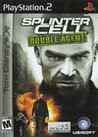 Tom Clancy's Splinter Cell Double AgentYour Score0 out of 10User Score
