For 6,656 reviews, this publication has graded:
-
41% higher than the average critic
-
5% same as the average critic
-
54% lower than the average critic
On average, this publication grades 2.1 points lower than other critics.
(0-100 point scale)
Average Movie review score: 63
| Highest review score: | London Road | |
|---|---|---|
| Lowest review score: | Melania |
Score distribution:
-
Positive: 2,521 out of 6656
-
Mixed: 3,814 out of 6656
-
Negative: 321 out of 6656
6656
movie
reviews
-
-
Reviewed by
Peter Bradshaw
Fares’s gaunt, handsome face so eloquently conveys vanity, but also a poignant emotional woundedness, anxiety and self-pity.- The Guardian
- Posted May 21, 2026
- Read full review
-
Reviewed by
-
-
Reviewed by
Jordan Hoffman
Director Kyle Patrick Alvarez deserves all the praise in the world for the way he cranks up this pressure cooker script. The Stanford Prison Experiment begins with giggles but ends in full psychological break.- The Guardian
- Posted Feb 1, 2015
- Read full review
-
Reviewed by
-
-
Reviewed by
Peter Bradshaw
The Little Stranger is fluently made and really well acted, particularly by Ruth Wilson, though maybe a bit too constrained by period-movie prestige to be properly scary.- The Guardian
- Posted Aug 30, 2018
- Read full review
-
Reviewed by
-
- Critic Score
Succeeds as a probing look into the mechanics of an epic lie, and because of the emotion at its heart.- The Guardian
- Posted Sep 17, 2013
- Read full review
-
-
Reviewed by
Jordan Hoffman
What Meadowland refuses to do, to its great credit, is conform to expectations.- The Guardian
- Posted Sep 22, 2015
- Read full review
-
Reviewed by
-
-
Reviewed by
Benjamin Lee
With Hathaway at its centre, The Idea of You is on far surer footing, in small moments almost threatening to be something far greater but settling into being perfectly acceptable instead, a plane movie par excellence.- The Guardian
- Posted May 1, 2024
- Read full review
-
Reviewed by
-
-
Reviewed by
Benjamin Lee
There’s real, seat-edge fun to be had here, the sort of fun that’s too often missing from modern horror.- The Guardian
- Posted Jun 30, 2021
- Read full review
-
Reviewed by
-
-
Reviewed by
Peter Bradshaw
With this startling and sombre documentary, Mexican film-maker Rodrigo Reyes has conducted an experiment in verbatim cinema, or what you might call witness cinema.- The Guardian
- Posted May 9, 2023
- Read full review
-
Reviewed by
-
-
Reviewed by
Catherine Shoard
Saturation point when it comes to quirkily dysfunctional families in over-soundtracked dramedies was reached long ago.- The Guardian
- Posted Sep 15, 2015
- Read full review
-
Reviewed by
-
-
Reviewed by
Leslie Felperin
It’s a thoughtful, honest and touching work, especially for women who love women, and also love canals.- The Guardian
- Posted Nov 15, 2018
- Read full review
-
Reviewed by
-
-
Reviewed by
Jonathan Romney
An all-star cast and some showstoppingly horrible hair can’t save Ridley Scott’s medieval epic.- The Guardian
- Posted Sep 10, 2021
- Read full review
-
Reviewed by
-
-
Reviewed by
Peter Bradshaw
As a formal experiment, Dry Leaf has its own conviction and self-possession and there is a deliberate, if opaque artistry here: one shot shows us a dry leaf under Irakli’s car-tyres, another gives us wet leaves in a waterfall. The soft-edged, pixelated look is, however, interesting and surprisingly watchable, bringing a kind of painterly effect.- The Guardian
- Posted Jun 15, 2026
- Read full review
-
Reviewed by
-
-
Reviewed by
Phuong Le
Thanks to the breezy chemistry between its largely Inuit cast, Slash/Back has an endearing charm that is hard to resist. From a first-time film-maker, this is a fresh, entertaining update on well-worn tropes.- The Guardian
- Posted Nov 16, 2022
- Read full review
-
Reviewed by
-
-
Reviewed by
Jordan Hoffman
It’s unfortunate that Byrne’s offering such a tremendous performance in a film that is, to put it as bluntly as possible, so very dumb.- The Guardian
- Read full review
-
Reviewed by
-
- Critic Score
The result would be hilarious if it weren't for its grisly and often deliberately pointed subject matter. There seems little to do but to laugh or retch. The fact that you may well do both at the same time is probably the film's intention. It has a serious point to make about the media's complicity in violence. But, in making it, it may well defeat its own ends with too many absurdist touches. [14 Jan 1993, p.8]- The Guardian
-
-
Reviewed by
Peter Bradshaw
Cine-narcissism like this is always tiresome, and it isn’t any more palatable in a European setting.- The Guardian
- Posted Aug 28, 2025
- Read full review
-
Reviewed by
-
-
Reviewed by
Leslie Felperin
It’s no surprise to learn Kostanski has worked as a special makeup artist on bigger budget projects such as Suicide Squad and It, but this proves he has a way with actors as much as a knack for latex and fake blood.- The Guardian
- Posted May 20, 2021
- Read full review
-
Reviewed by
-
- Critic Score
Despite Fine’s conversational interviewing, Wilson is still not enormously articulate or forthcoming, though it’s nice to see him reminisce, however simply, and there are plenty of powerful, telling moments.- The Guardian
- Posted Jan 20, 2022
- Read full review
-
-
Reviewed by
Leslie Felperin
Like a lot of topline Korean films, this prestige action thriller is a little too long at 137 minutes, but it’s consistently entertaining throughout, and quite well-suited given the length to being viewed on a streaming platform.- The Guardian
- Posted Mar 30, 2023
- Read full review
-
Reviewed by
-
-
Reviewed by
Cath Clarke
This is a film raised a fair few notches by the wonder of geekery, the absolute joy of seeing scientists living and breathing their work.- The Guardian
- Posted Apr 4, 2022
- Read full review
-
Reviewed by
-
-
Reviewed by
Leslie Felperin
Even if the antics shown here aren’t really your thing, it is still a hoot seeing Gwar members get interviewed by a game Joan Rivers: you can tell that beneath all the latex most of them are sweet, normal folk who remained loyal (mostly) to one another and shared a vision for the group.- The Guardian
- Posted Jul 19, 2022
- Read full review
-
Reviewed by
-
-
Reviewed by
Benjamin Lee
For those who like their dating movies with a bit of gristle, Fresh is a perfect match.- The Guardian
- Posted Jan 22, 2022
- Read full review
-
Reviewed by
-
-
Reviewed by
Peter Bradshaw
At all events, [Nemes] undoubtedly brings impeccable craftsmanship, and the performances and production design are strong.- The Guardian
- Posted May 18, 2026
- Read full review
-
Reviewed by
-
-
Reviewed by
Peter Bradshaw
The action is wrapped up with a slightly ridiculous reveal, which doesn’t quite make sense on its own terms, but Perfect Blue has its own kind of cult pungency.- The Guardian
- Read full review
-
Reviewed by
-
- Critic Score
Had the film been contained by its clever premise - the Minions must fight to preserve their place in Hollywood – it might have achieved the crystalline simplicity that is a hallmark of good children’s films. But aiming to both lead the Minions in a newer, smarter direction and appease the gibberish-fest expectations set by the franchise, Coffin bites off more than he can chew.- The Guardian
- Posted Jun 30, 2026
- Read full review
-
-
Reviewed by
Peter Bradshaw
The film is watchable in its quirky and wayward way, with some funny moments – though shallower than it thinks.- The Guardian
- Posted Feb 18, 2017
- Read full review
-
Reviewed by
-
- Critic Score
The screenplay by Deric Washburn and Michael Cimino (later to collaborate on The Deer Hunter) and Steven Bochco (of subsequent Hill Street Blues fame) delivers its ecological message with humour and imagination, and Joan Baez sings the appropriate songs.- The Guardian
- Read full review
-
-
Reviewed by
Peter Bradshaw
Annette is a forthright and declamatory and crazy spectacle, teetering over the cliff edge of its own nervous breakdown, demanding that we feel its pain, feel its pleasure and take it seriously.- The Guardian
- Posted Jul 6, 2021
- Read full review
-
Reviewed by
-
-
Reviewed by
Jordan Hoffman
Jason Clarke is strong as the weak senator, and he wisely goes easy on replicating the unmistakable Massachusetts accent.- The Guardian
- Posted Mar 2, 2018
- Read full review
-
Reviewed by
-
-
Reviewed by
Henry Barnes
Vitthal's film is full of heart, but overly ambitious. He could have made it easy on himself and steered us down a much more familiar route. Instead he delivers a moralistic story that's pure in its intention and a real slog to watch.- The Guardian
- Posted Jan 26, 2014
- Read full review
-
Reviewed by
-
-
Reviewed by
Peter Bradshaw
The King of Staten Island is not structurally perfect. There is a rather contrived crisis the purpose of which is to bring Claire, Scott and Ray together at last, but there is charm and gentleness in this new stepfamily. Powley’s performance and the final shots of the Staten Island ferry brought back happy memories of Joan Cusack in Mike Nichols’s 80s classic, Working Girl. There are a lot of laughs here.- The Guardian
- Posted Jun 8, 2020
- Read full review
-
Reviewed by
-
-
Reviewed by
Peter Bradshaw
It's often entertainingly creepy in a twilit world of its own.- The Guardian
- Read full review
-
Reviewed by
-
-
Reviewed by
Steve Rose
This is the second highest-grossing movie of the year in Japan, but unless you’re a teenager, an anime junkie or really, really care about volleyball, you’re unlikely to get much out of it.- The Guardian
- Posted May 28, 2024
- Read full review
-
Reviewed by
-
- The Guardian
- Posted Sep 10, 2025
- Read full review
-
-
Reviewed by
Ellen E Jones
To watch Tesla the film is to admire its ambition while regretting its follies. Much like Tesla the man, perhaps?- The Guardian
- Posted Sep 28, 2020
- Read full review
-
Reviewed by
-
-
Reviewed by
Peter Bradshaw
Anyone who says voting is a waste of time needs to watch this film.- The Guardian
- Posted Jul 23, 2019
- Read full review
-
Reviewed by
-
-
Reviewed by
Henry Barnes
The Perks of Being a Wallflower is a perfect fit for its target audience – the Harry Potter kids who are following Emma Watson through her baby steps towards the stronger stuff.- The Guardian
- Posted Sep 13, 2012
- Read full review
-
Reviewed by
-
- The Guardian
- Posted Jun 19, 2019
- Read full review
-
-
Reviewed by
Catherine Bray
This is a fascinating and neatly realised horror riff on the 2020s’ most popular genre.- The Guardian
- Posted Oct 20, 2025
- Read full review
-
Reviewed by
-
-
Reviewed by
Peter Bradshaw
Love and sex, two things taken so casually for granted in so many different kinds of story, here become totemic articles of faith. Lady Chatterley still has the power to move.- The Guardian
- Posted Nov 29, 2022
- Read full review
-
Reviewed by
-
-
Reviewed by
Peter Bradshaw
The psychological thriller form has imposed on Dolan some discipline, and brought out his talent and energy.- The Guardian
- Posted Aug 13, 2015
- Read full review
-
Reviewed by
-
-
Reviewed by
Peter Bradshaw
Vie Privée canters along to a faintly silly, slightly anticlimactic conclusion and audiences might have been expecting a bigger and more sensational twist. Yet Foster’s natural charisma sells it.- The Guardian
- Posted May 24, 2025
- Read full review
-
Reviewed by
-
-
Reviewed by
Luke Buckmaster
Sissy is a deranged pleasure to watch, though a strong stomach and an appreciation of genre protocols is highly recommended.- The Guardian
- Posted Nov 2, 2022
- Read full review
-
Reviewed by
-
-
Reviewed by
Peter Bradshaw
It's an amiable film with some great musical moments and the classic "growing success" montage showing them on the road in south-east Asia. On music, identity and race, the film has a big beating heart in the right place.- The Guardian
- Posted Mar 3, 2013
- Read full review
-
Reviewed by
-
-
Reviewed by
Xan Brooks
Schirman's film (produced by the team behind Man on Wire and Searching For Sugarman) is as gripping as any high-concept Hollywood thriller and as psychologically knotty as Greek tragedy.- The Guardian
- Posted Jul 7, 2014
- Read full review
-
Reviewed by
-
-
Reviewed by
Phuong Le
Instead of letting the visuals do the talking, the voiceover steps in to verbalise the characters’ feelings, and the need to provide multiple backstories through flashback veers into over-exposition. Still, Departures remains a highly thoughtful exploration of love and identity, and an excellent showcase for northern talents on film.- The Guardian
- Posted May 8, 2026
- Read full review
-
Reviewed by
-
-
Reviewed by
Mike McCahill
Levine succeeds in giving some genre tropes renewed sheen. Even a rote-seeming, Rogen-initiated drug trip pays off with the cherishable sight of Theron conducting state business with glitter in her hair.- The Guardian
- Posted May 5, 2019
- Read full review
-
Reviewed by
-
- Critic Score
Crystal Fairy is an acid trip where the frequent bonhomie is doused by sobering introspection.- The Guardian
- Posted Apr 9, 2013
- Read full review
-
-
Reviewed by
Benjamin Lee
It’s just a rare joy to see a film-maker scrambling together overused tropes and making something so vibrant and vital as a result, an exciting and unexpected studio movie with a brain, some guts and a heart.- The Guardian
- Posted Nov 11, 2020
- Read full review
-
Reviewed by
-
-
Reviewed by
Jesse Hassenger
The soul of the movie isn’t particularly in the human/creature relationship at its center, but in the stunning craftsmanship that surrounds (and in the creature’s case, creates) them.- The Guardian
- Posted Apr 17, 2025
- Read full review
-
Reviewed by
-
- Critic Score
This assured debut tells us teenage girls can – and will – save themselves.- The Guardian
- Posted Aug 17, 2016
- Read full review
-
-
Reviewed by
Catherine Shoard
There’s something about the franchise’s earnest investment in its characters that’s quite unique. Its longevity is because it functions as much as a soap as an action flick.- The Guardian
- Posted Mar 25, 2015
- Read full review
-
Reviewed by
-
-
Reviewed by
Charles Bramesco
Whannell’s finite reserves of creativity have been meted out in an imbalance, going all in on world-building while giving the fight choreography and the cinematography listlessly documenting it the short shrift.- The Guardian
- Posted May 31, 2018
- Read full review
-
Reviewed by
-
-
Reviewed by
Henry Barnes
Ahadu pulls the curtain back on a government that was willing to imprison and torture its electorate.- The Guardian
- Posted Aug 6, 2012
- Read full review
-
Reviewed by
-
-
Reviewed by
Phuong Le
Despite beings shaky in terms of tone – as well with its occasionally obtrusive handheld camera movements – Lola impresses with its refreshing blend of analogue and digital flourishes.- The Guardian
- Posted Aug 4, 2023
- Read full review
-
Reviewed by
-
-
Reviewed by
Benjamin Lee
Patti Cake$ is by no means a hopelessly bad movie, it’s just hampered by its desperate need to be a crowd-pleaser.- The Guardian
- Posted Aug 14, 2017
- Read full review
-
Reviewed by
-
- Critic Score
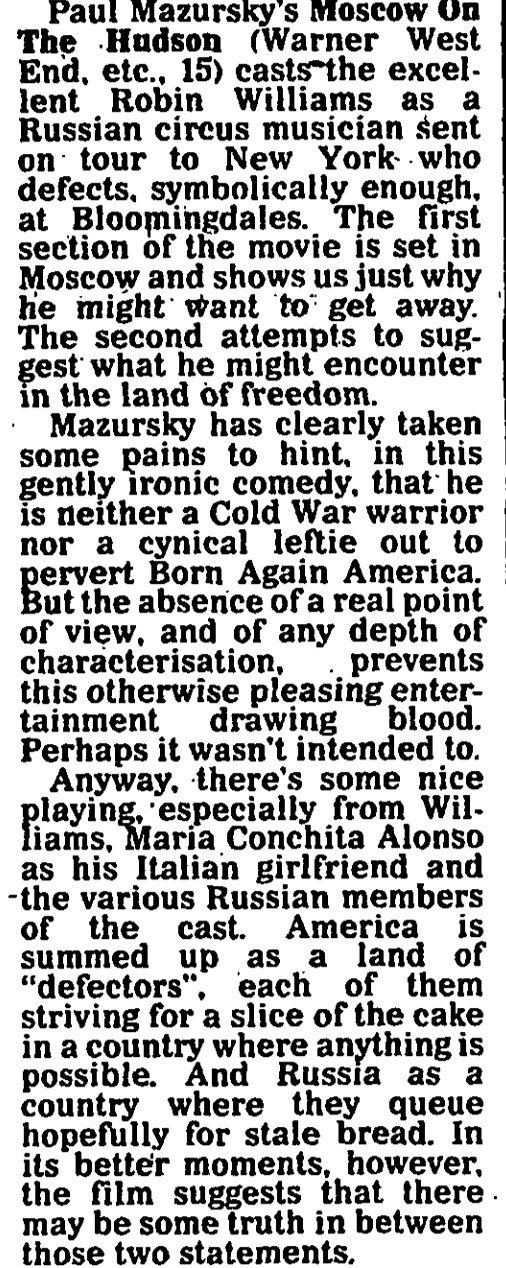
The absence of a real point of view, and of any depth of characterisation, prevents the otherwise pleasing entertainment drawing blood.- The Guardian
- Read full review
-
-
Reviewed by
Peter Bradshaw
It’s fun, though GOTG2 doesn’t have the same sense of weird urgency and point that the first film had. They’re still guarding, although the galaxy never seems in much danger.- The Guardian
- Posted Apr 24, 2017
- Read full review
-
Reviewed by
-
-
Reviewed by
Benjamin Lee
Try as writer-director Mike Flanagan might, there’s something coldly unmoving about it all, a disjointed and dry-eyed tearjerker that never rises above Instagram caption philosophy.- The Guardian
- Posted Jun 5, 2025
- Read full review
-
Reviewed by
-
-
Reviewed by
Leslie Felperin
It's certainly atmospheric and cool in a new-New Wave way, but really, what's the point?- The Guardian
- Posted Aug 14, 2014
- Read full review
-
Reviewed by
-
-
Reviewed by
Leslie Felperin
Tran adroitly layers the fight sequences, filmed with fluidity and at least substantially performed by the main actors themselves, between frothy layers of blokey banter.- The Guardian
- Posted Sep 13, 2021
- Read full review
-
Reviewed by
-
-
Reviewed by
Jordan Hoffman
There are plenty of great moments, but they jump out amid a jumble of strangely flat scenes. This doesn’t feel like the work of a great master; it’s a discordant brew that just doesn’t blend right.- The Guardian
- Posted Jan 20, 2018
- Read full review
-
Reviewed by
-
-
Reviewed by
Peter Bradshaw
It is a good idea and there are good moments in the film, especially at the very beginning when Anna and Aleks have a bizarre encounter with the old woman herself, Rita Concannon, strikingly played by Olwen Fouéré. But then things begin to slide. There are however some resonant ideas here.- The Guardian
- Posted Apr 17, 2024
- Read full review
-
Reviewed by
-
-
Reviewed by
Xan Brooks
If it's possible for a picture to be at once ideal and imperfect, then Damsels fits the bill.- The Guardian
- Posted Apr 5, 2012
- Read full review
-
Reviewed by
-
-
Reviewed by
Peter Bradshaw
It is a wildly silly, wildly entertaining adventure which periodically gives us a greatest-hits flashback montage of the other seven films in the M:I canon - but we still get a brand new, box-fresh Tom-sprinting-along-the-street scene, without which it wouldn’t be M:I.- The Guardian
- Posted May 14, 2025
- Read full review
-
Reviewed by
-
-
Reviewed by
Peter Bradshaw
It’s powerfully and pugnaciously acted, and horses are brought in – as animals often are in social-realist movies – as symbols of redemptive nobility. But I felt that in narrative terms it turned into a cul-de-sac of macho violence.- The Guardian
- Posted Jul 31, 2020
- Read full review
-
Reviewed by
-
-
Reviewed by
Cath Clarke
Talley strikes you as a man of sincerity and depth behind all the air-kissing and lamé.- The Guardian
- Posted Oct 2, 2018
- Read full review
-
Reviewed by
-
-
Reviewed by
Peter Bradshaw
As with the last film, there are bold extravagant gestures of spectacle, while Wright, Coel, Bassett, Gurira and Thorne all supply fierce performances; each of them ups the onscreen voltage simply by appearing.- The Guardian
- Posted Nov 8, 2022
- Read full review
-
Reviewed by
-
-
Reviewed by
Ellen E Jones
While Harrison’s performance may never fully reveal the nature of the man beneath these sumptuous layers of organza, silk and self-confidence, it’s enchanté Chevalier, all the same.- The Guardian
- Posted Jun 7, 2023
- Read full review
-
Reviewed by
-
-
Reviewed by
Peter Bradshaw
This really is a very strange film, and perhaps doesn’t quite cohere the way a more rigorously refined and redrafted screenplay might, but each of its exotic elements suggests a mounting delirium – exactly the kind of unacknowledged, displaced group frustration that grows and metastasises in a police state.- The Guardian
- Posted Jul 10, 2023
- Read full review
-
Reviewed by
-
-
Reviewed by
Peter Bradshaw
The rock’n’roll bad boy of tennis is watchably if uncritically celebrated in this documentary portrait by Barney Douglas; it is a film that leaves unsolved the riddle, if it is a riddle, of John McEnroe’s confrontational on-court personality.- The Guardian
- Posted Jul 14, 2022
- Read full review
-
Reviewed by
-
-
Reviewed by
Leslie Felperin
The whole package is an easily digested guilty pleasure.- The Guardian
- Posted Jan 26, 2026
- Read full review
-
Reviewed by
-
-
Reviewed by
Luke Buckmaster
In the new film, by literally creating a bust of the bird – as if a clump of stone or plaster could compare with the natural majesty of wings and feathers – the meaning has been accidentally inverted: a story about how something can never die becomes about how it will never live again.- The Guardian
- Posted Mar 26, 2019
- Read full review
-
Reviewed by
-
- The Guardian
- Posted Oct 3, 2019
- Read full review
-
-
Reviewed by
Peter Bradshaw
It’s a charismatic performance from Adewunmi, and Amoo’s camera often comes in close to his face and his gaze, suggesting that Femi is on the verge of some kind of epiphany or vision – and it’s nothing to do with the drugs.- The Guardian
- Posted Oct 10, 2019
- Read full review
-
Reviewed by
-
-
Reviewed by
Peter Bradshaw
There are substantial talents involved in this film, but it doesn’t come together.- The Guardian
- Posted Jan 5, 2017
- Read full review
-
Reviewed by
-
-
Reviewed by
Catherine Bray
It uses its supernatural premise to explore some very human behaviour.- The Guardian
- Posted Aug 20, 2025
- Read full review
-
Reviewed by
-
-
Reviewed by
Leslie Felperin
Both actors contribute knife-sharp timing and the kind of intensity needed to make this essentially two-man setup work.- The Guardian
- Posted Sep 9, 2021
- Read full review
-
Reviewed by
-
-
Reviewed by
Peter Bradshaw
It’s a vehement movie, with a driving narrative force and a robust sense of time and place.- The Guardian
- Posted Feb 25, 2023
- Read full review
-
Reviewed by
-
-
Reviewed by
Peter Bradshaw
This is a powerful and important documentary, though I have one tiny qualification.- The Guardian
- Posted Nov 22, 2023
- Read full review
-
Reviewed by
-
-
Reviewed by
Peter Bradshaw
Silver Haze is a sombre, thoughtful film about depression and what is (and isn’t) likely to promote emotional healing, performed with openness and honesty.- The Guardian
- Posted Mar 27, 2024
- Read full review
-
Reviewed by
-
-
Reviewed by
Peter Bradshaw
Power Ballad is about making it and dreaming big, about every busker never giving up on hopes of one day being mega. But as so often with Carney, it’s about something else, usually left unacknowledged in movies about music or any sort of showbusiness: the terrible binary of success and failure.- The Guardian
- Posted May 27, 2026
- Read full review
-
Reviewed by
-
- The Guardian
- Posted Jun 12, 2025
- Read full review
-
-
Reviewed by
Phil Hoad
Conti manages the feat of being funny, emotionally astute and kinda sexy throughout.- The Guardian
- Posted Oct 16, 2025
- Read full review
-
Reviewed by