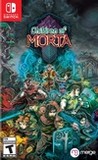
As the narrator of Children of Morta would say: "A couple of runs was all it took, to spark my love for this game. But the human heart is finicky, and the honeymoon didn't last. Midway through the journey, what was once love had turned sour, regret taking its place. Then, as the end approached, that regret too gave way to serene acceptance."
Sorry, I couldn't resist.
Children ofAs the narrator of Children of Morta would say: "A couple of runs was all it took, to spark my love for this game. But the human heart is finicky, and the honeymoon didn't last. Midway through the journey, what was once love had turned sour, regret taking its place. Then, as the end approached, that regret too gave way to serene acceptance."
Sorry, I couldn't resist.
Children of Morta is a hard game to review, because it swings wildly between high and low points. The story is good: an epic fable that's laser-focused on the theme of family bonds, narrated in voiceover by a strong actor. Yeah, it's a bit overwritten, but it tackles ponderous subjects such as grief and the responsibilities of parenthood. So there is that.
In the “good but…” department, you can file the "hi-pixel" graphics. They're hit-and-miss, but when they's good, they're really good, with beautiful vistas and intricate detail. The main gameplay loop is also OK, if unoriginal: Children of Morta is another take on the fashionable roguelike template, with the addition of multiple characters with separate (but somewhat interacting) skill trees. It's addictive, no question about that.
All of the above would make Children of Morta a must-play, if it were not for its glaring downsides. The game's implementation is glitchy, especially in the graphics department. The frame rate can drop to single digits in some extreme cases. More importantly, the game isn't very well designed in general. Difficulty is all over the place, and it feels like the designers had more ideas than they could balance and tune.
Here is a concrete example of that half-done design job: for a few levels, I did what the game seemed to ask me: I switched from one character to another. The game even has a few mechanics that encourage you to do that. At some point, however, I realized that it's more productive to ignore those mechanics and play with one or two overpowered characters all the time. Some characters are so much more powerful than the others, that mechanics be damned, you don't want to play a loser.
Another example: for a while, I tackled combat and exploration in a slow and methodical way. Then I understood that I was wasting my time. The game becomes much easier if you just rush from one treasure chamber to the next, assembling a tail of hapless pursuing enemies. Treasures chambers are mostly safe, and you can shoot through their doors, while the enemies can't–so they become sitting ducks ready for you to kill and farm some XP. You can cheese your way through most of the game like that, and that also makes all the enemies feel exactly the same as one another. This kind of glaring gameplay issue should have been caught immediately during beta testing.
Still another example of shaky design: the mini-games that litter the dungeons feel like the designer was asked to come up with ideas in a few minutes. One is a very out-of-place game of pong. Another one requires you to step over four buttons in order–but you can only find the right order through trial and error. One wrong try, and you have to wipe out a room full of enemies before you try again. Do a little math, and you'll see that even if you never forget the sequence, you might have to clean up that room a maximum of 24 times if you're unlucky. I had to do it 12 times once, and then I stopped caring about this kind of room when I encountered it. This pointless "challenge" should never have been included in the game.
I could talk more about a few bullet sponge bosses, unbalanced recovery times, and the like–but you got the idea: Children of Morta has great potential, but it should have gone through a few more passes of design review. As it is, this game is an incomplete curio. It's still worth playing, and at times it feels uniquely its own–but at the same time, it feels like a missed opportunity for a minor classic.… Expand