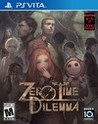
ZTD is the finale of the Zero Escape series which consists of Nine Hours, Nine Persons, Nine Doors (999) and Virtue's Last Reward (VLR)
The only people that need to play ZTD are the fans who made it worth making, but unfortunately for them, instead of a beautiful endpiece to what was potentially one of the most intriguing video game trilogies out there, fans are treated to ... well, IZTD is the finale of the Zero Escape series which consists of Nine Hours, Nine Persons, Nine Doors (999) and Virtue's Last Reward (VLR)
The only people that need to play ZTD are the fans who made it worth making, but unfortunately for them, instead of a beautiful endpiece to what was potentially one of the most intriguing video game trilogies out there, fans are treated to ... well, I guess something like a McD's apple pie; you enjoy it somewhat, but it's never satisfying, you feel like crap afterwards, and you always know that it'll never be as good as the real thing.
Sure, the minds behind the amazing 999 and VLR prequels have returned for this third and final entry in the Zero Escape series, but whether budget or burnout was the main factor, the end result is a lackluster finale to a series that most-definitely deserved better. The joy of the series has never been its gameplay, really, but how it uses the medium to unravel a complex narrative. The Zero Escape series and indeed Zero Time Dilemma are essentially visual novels that hinge on player choices and feature room-escape puzzles. In 999, the story is so expertly crafted to bring you to its mind-blowing conclusion. The twists and turns of the original game were so well-done that we hardly minded some of the more glaring issues like having to re-solve the rooms to see the different endings. In VLR, the prose is less heavy-handed and you're stuck with your choices like in 999, but rather than have you go back and replay all the rooms to see the other branches of the story, it introduced the game flowchart which at first blush seemed only to exist in order to address complaints from 999... until you realize it's much more than that, and it is pure genius! There's also that nice little twist where the memos you write degrade over time just like short-term memory.
Which brings us to ZTD, in which fans hope all of the questions they have will get answered. They don't. To be fair, a lot of gaps will be filled in, but it's done in such a ridiculous and disjointed way that by the end of it all, you might find yourself not really caring anymore. Again, new players need not look at this at all until they have played the first two games, or at the very least, VLR. So dependent on its prequels is ZTD that anyone jumping in at this point will be totally lost, which makes it a wonder why over 60% of the game is spent re-establishing stuff we learned in VLR. The recap is boring for fans and will make no sense to newbies.
Onto brass tacks. ZTD is instantly familiar to fans of the series. Once again, you will be making choices and escaping rooms. Familiar characters return and a few new faces debut, but they are so un-noteworthy that I didn't even know Mira's name until well into the final wrap-up. The twists are here as well, but I doubt any one of them could be considered mind-blowing. Gone is all of the prose and the game plays out in cutscenes with terrific-looking cel-shaded models that, in contrast, appear to be animated by high school kids still learning how to point and move the camera. Rather than show any complex movements, the camera will cut away to a wall or the ceiling in order to obviously re-pose the characters. When you do see them move, it's laughable - even the short character loops of VLR were done better than this. But that's not why you came - if we wanted pretty, we'd never have jumped into Zero Escape in the first place. It's all about the story, so what of it?
Fans of the series are used to slow burn, but the unraveling of the yarn here is S-L-O-W slow, and as I said above, most of it is going to be redundant re-treading for fans returning to see the conclusion and will be completely lost on anyone who hasn't at least played VLR. Rather than going through one entire playthrough as in previous games, ZTD is instead presented in disjointed segments that can be explored in any order provided you have unlocked them. Meticulous players might want to look at the global flowchart (accessible right off the bat) to try and make sense of things, but ZTD doesn't really play out that way. The characters are once again trapped in a shelter and made to escape rooms and make decisions, but every time they're done, the new Zero (the bad guy) knocks them out, erases their memories, and they start again somewhere else. Players will need to fill in the gaps and make sense of this disjointed storytelling, but it's not done nearly as well as in the prequels. My personal experience had me trying this until I slowly began to feel a disconnect as the game plodded on and told me nothing of use. The mystery isn't nearly as intriguing this time and really, YMMV on the payoff. As for the rooms, there's no files to find, and no math to do. They're all easy to navigate and solve. It all feels phoned in without any of the love.
ZTD is only for fans who want to see the conclusion, but they should keep expectations nice and low. Like for a McD's apple pie.… Expand

 Zero Escape: Zero Time DilemmaYour Score0 out of 10User Score
