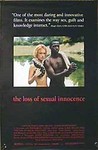




Summary:The Loss of Sexual Innocence is the story of Nic, told through the crucial, sometimes humorous and often heart-breaking episodes of his life. We catch glimpses of what makes Nic the man that he is, tracing incidents that happen to him as a five year old boy, as a twelve year old adolescent, as a 16 year old teenager, and as a fully grownThe Loss of Sexual Innocence is the story of Nic, told through the crucial, sometimes humorous and often heart-breaking episodes of his life. We catch glimpses of what makes Nic the man that he is, tracing incidents that happen to him as a five year old boy, as a twelve year old adolescent, as a 16 year old teenager, and as a fully grown man.
Cross-cut with the tale of Nic is the classic parable of Adam and Eve, which serves as an allegory to the events of Nic's life and, the two tales intertwined, ultimately serves as a powerful summation of the loss of innocence of not just Nic, but of the humanity of our species. (Sony Pictures Classics)…Expand
Wow. The critics really didn't hold back on this one, did they? I suppose that's to be expected. It's far easier to disparage something than admit you don't understand it. [That the psychiatric term for such behavior (projection) is an irony not lost on me.] But what if a movie isn'tWow. The critics really didn't hold back on this one, did they? I suppose that's to be expected. It's far easier to disparage something than admit you don't understand it. [That the psychiatric term for such behavior (projection) is an irony not lost on me.] But what if a movie isn't necessarily meant to be understood, or not meant to be understood within the paradigm of traditional narrative moviemaking that most viewers are familiar with? I mean, of course a movie that's oddly structured, confoundingly abstruse, and willfully inarticulate is going to be difficult to understand in traditional terms. For what it's worth, this has to be a difficult movie to apprise as a critic. Many of the criticisms hurled at it ("It's consciously arty", "It's willfully opaque", "Gold-plated navel gazing", "Dumbfoundingly pretentious") are mostly accurate. Mike Figgis works at the periphery of commercial film. He is a director unafraid of experimentation, and nothing fascinates him more than the act of storytelling, or, more specifically, the methodical action of storytelling. In his films, the manifestation of this fascination can be painfully overt, as in a later Figgis film with a title either brilliantly simple or embarrassingly on-the-nose. Time Code, shot simultaneously on 4 cameras with the output of each taking up a quadrant of the movie screen, unfolds in real time without the use of editing, at least in the traditional sense. In a way, the four separate perspectives and what each is charged with capturing constitutes an editorial format for the film. [If Figgis is still actively making films today (which, unfortunately, doesn't seem to be the case), I can only imagine the prospect of 360 degree cameras has him positively frothy.] Nevertheless, Time Code is an intriguing experiment in filmmaking that resulted in a less intriguing commercial film. Some may argue it's more experimental than commercial, which makes me profoundly hopeful for a forthcoming experimental film starring Jeanne Trippelhorn as a Scotch-swilling film executive cheating on her wife with a male subordinate. Time Code's experimentation with the methodical action of storytelling defined everything about the movie to an extent that was off-putting. Seeing Time Code and this film back-to-back, you'd be forgiven for questioning whether both films were even made by the same man.
In the case of The Loss of Sexual Innocence, Figgis runs the other direction, embracing the symbolic time-splitting of traditional film editing to a woozy degree. This film very much does not run in real time. It also eschews most aspects of traditional narrative filmmaking altogether. That there's not a story in the traditional sense doesn't make The Loss of Sexual Innocence any less fascinated with the way it tells its story. Here, the methodology takes a very different tact, embracing storytelling as a conveyor of textural mood and semi-universal truths rather than as a concrete description of an event. Beyond the many aspersions cast its way relating to it being too "arty," There's not much for a critic of more standard fare to hang a hat on. But, like any great art, the experience is informed as much by the viewer and whatever subjective baggage they've brought with them as it is by the content itself. In other words, your opinion on this film depends a whole lot on your personal experience and related expectations for it. If you want to see a film that has a beginning, middle, and end, and whose pieces all neatly relate to each other, and that telegraphs in which emotion you should be feeling at the moment, I'd say avoid this one. Mike Figgis asks a lot of his audiences, more than I think he even realizes. His obsession with the methodology of storytelling often manifests in ways that feel like they're actively pushing a viewer away, discouraging identification or connection with what's on the screen, and actively prohibiting the viewer from the "suspension of disbelief" through which we watch a "normal" film. Figgis' work in many ways reminds me of another director of "difficult" films who nevertheless receives more accolades despite not hewing to convention: David Lynch. The Loss of Sexual Innocence is Figgis at his most Lynchian. Mr. Lynch often talks about his work as a painter first and filmmaker second, and how he's more concerned with relating the ephemeral qualities of how something feels than by what it means. Figgis embraces something similar here, and painterly qualities like suggestiveness, evasion of meaning, obfuscation of intent, and, indeed, everything that makes the arty criticisms valid, result in a film that asks a lot more of its viewers than they may be used to. Whether that makes it a "successful" film is almost irrelevant. I'll simply say that in working in such a manner, Figgis has made a movie that I find beautiful, deeply haunting, and both broadly evocative and singularly provocative. To me, it's art.…Expand