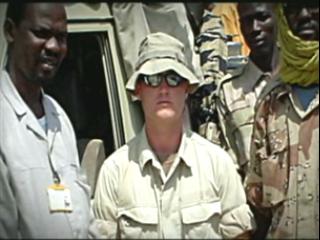







Summary:The Devil Came on Horseback exposes the tragedy taking place in Darfur as seen through the eyes of an American witness who has since returned to the US to take action to stop it. Using the exclusive photographs and first hand testimony of former U.S. Marine Captain Briahn Steidle, The Devil Come on Horseback takes the viewer on anThe Devil Came on Horseback exposes the tragedy taking place in Darfur as seen through the eyes of an American witness who has since returned to the US to take action to stop it. Using the exclusive photographs and first hand testimony of former U.S. Marine Captain Briahn Steidle, The Devil Come on Horseback takes the viewer on an emotionally charged journey into the heart of Darfur, Sudan, where an Arab run government is systematically executing a plan to rid the province of it's black African citizens. As an official military observer, Steidle had access to parts of the country that no journalist could penetrate. He was unprepared for what he would witness and experience, including being fired upon, taken hostage, and being unable to intervene to save the lives of young children. Ultimately frustrated by the inaction of the international community, Steidle resigned and returned to the US to expose the images and stories of lives systematically destroyed. (Break Thru Films)…Expand
It's a bold move or even statement to open a documentary with various images depicting quite gruesome and nightmare-ridden scenes, and this documentary doesn't stop until some sort of message is nailed into your memory.
Brian Steidle, a former U.S. Marine captain, documents his time inIt's a bold move or even statement to open a documentary with various images depicting quite gruesome and nightmare-ridden scenes, and this documentary doesn't stop until some sort of message is nailed into your memory.
Brian Steidle, a former U.S. Marine captain, documents his time in Sudan during the Darfur conflict, here he is working for the African Union simply because he didn't want a "desk job" to further his training in the Marine Corps. He chronicles his time with only a camera, pen and paper as he makes it his mission to expose exactly what he has witnessed. With his military status, Brian had access to many parts of the Darfur that would otherwise be closed to the public, he watches as the rebel forces burn villages to the ground, a very publicised and horrific civil war.
Brian does a voiceover of various diary entries and emails sent back home to show just what is life was like when he was there. His meetings with the Janjaweed, arebel force who are funded by the Sudanese government, something they continuously deny, are quite powerful for the fact that their honesty can be overwhelming, and the acts of genocide committed from these parties might just be the most painful thing you could watch.
In terms of a film, the close-quarter shots and aerial views of burning villages are a proper reminder of the very real dangers going on and being shown. Many times Brian puts his life in danger, not necessarily for the perfect shot, but so he can show the world exactly what is happening, in an attempt to stop it. As he speaks about the moment the US government recognised the crimes as genocide, the distain in his voice can be heard, he has seen what is happening but the lack of action is apparent as the atrocities continue.
His inability to help, something he wasn't supposed to do, is clear as the film goes on, and he eventually decides its time to go.
The unfortunate barrier of politics and right way to do things initially stalled Brian from sharing his experience, but newspapers are a powerful agent, and so the truth came out.
Brian's candid and emotionally driven experiences are what makes this documentary so riveting, tragic but fascinating. But a word of warning, the pictures may never leave you, but perhaps that's the point.…Expand
0 of 0 users found this helpful00
8
ChadS.
Jan 14, 2008
The subject does refer to himself in the third person(and has a Ray Liotta-like laugh) early on in "The Devil Came on Horseback" as he recounts his prospects of being a paper jockey in an office, but when he cries on camera, we believe this Marine Captain. After all, genocide is something The subject does refer to himself in the third person(and has a Ray Liotta-like laugh) early on in "The Devil Came on Horseback" as he recounts his prospects of being a paper jockey in an office, but when he cries on camera, we believe this Marine Captain. After all, genocide is something to cry about. Since the ex-Marine acts as our narrator, the story of Darfur is abridged by his limited knowledge. He knows the "when" and "where"; the external particulars of Khartoum's collaboration with the Janjaweed, but not the "why"; the historicism of African/Arab relations in the Sudanese region. "The Devil Came on Horseback" has a narrow scope. This doc is about one man's relationship to human tragedy. It's an indoctrination tool, a user-friendly film about a particular current event. What "The Devil Came on Horseback" lacks in insight, it more than makes up with the photographs that documents an innumerable amount of casual hate crimes against the Sudanese people. And sadly, "The Devil Came on Horseback" gives us one more reason to be embarrassed about our current administration.…Expand