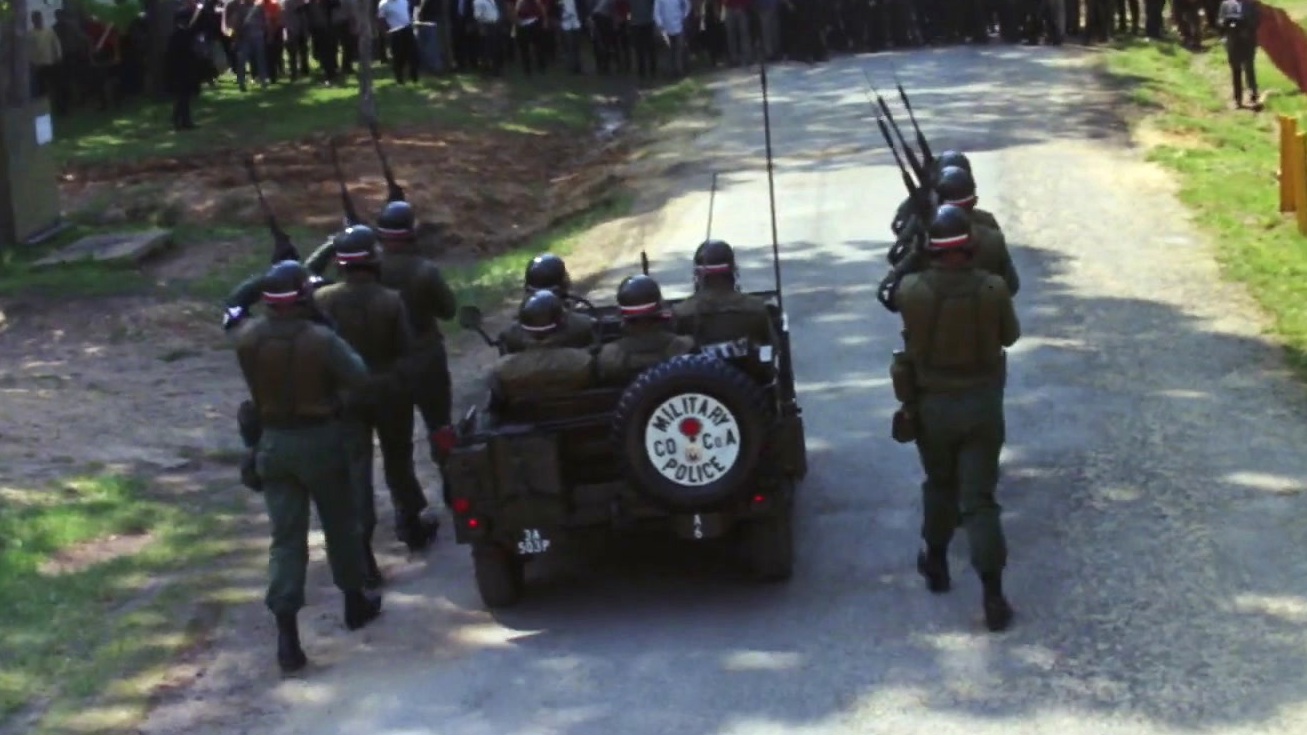
Summary:Focusing on unearthed military training footage of Army-built model towns called Riotsvilles, where military and police were trained to respond to civil disorder in the aftermath of the Kerner Commission created by President Lyndon B. Johnson, director Sierra Pettengill’s kaleidoscopic all-archival documentary reconstructs the formation ofFocusing on unearthed military training footage of Army-built model towns called Riotsvilles, where military and police were trained to respond to civil disorder in the aftermath of the Kerner Commission created by President Lyndon B. Johnson, director Sierra Pettengill’s kaleidoscopic all-archival documentary reconstructs the formation of a national consciousness obsessed with maintaining law and order by any means necessary. Drawing insight from a time similar to our own, Riotsville, U.S.A. pulls focus on American institutional control and offers a compelling case that if the history of race in America rhymes, it is by design.…Expand
It’s unfortunate when a film has an important message to convey but does a poor job of saying what it has to say. That’s the problem with this documentary about the policies and practices underlying government efforts to control violent civil disobedience in major US cities during the mid toIt’s unfortunate when a film has an important message to convey but does a poor job of saying what it has to say. That’s the problem with this documentary about the policies and practices underlying government efforts to control violent civil disobedience in major US cities during the mid to late 1960s. It focuses on the training programs employed at US Army bases where model cities (called “Riotsville”) were built to stage simulated disturbances used for instructing military and police forces on how to quell such outbreaks in line with official government policies. But the film goes beyond that, trying to explain why these incidents were occurring with increasing frequency at the time and why such extensive training measures had become necessary. In doing so, the picture examines the frustrations associated with, and subsequent reactions to, the issues of poverty, racism, police brutality, inequality and the impact of the Vietnam War, among others, principally in minority inner city communities. It tells this story using only archive footage from the time, drawn from television broadcasts and official US military training films. However, given the broad scope of this story, director Sierra Pettengill’s third feature outing doesn’t delve nearly deep enough into these issues, somewhat surprising given the wealth of material at the filmmaker’s disposal. Nor does it tie the Riotsville project to these larger questions as well as it could, relying more on implication than connection. Moreover, this shallow, underdeveloped approach is further undercut by a number of poorly chosen video segments and others in desperate need of editing out extraneous content. Add to that far too many explanatory subtitles and a number of dull, overwritten voiceovers seeking to philosophically elaborate on its conclusions, and you’ve got a watered down presentation of material deserving to be delivered with a greater sense of hard-hitting urgency. This is the sort of film that should make audiences angry, not put them to sleep, but this offering does more to promote the latter than the former. This is a story that would have been better told through more skillful directorial hands for it to have the impact it requires. Unfortunately, that’s not the case here.…Expand
Boring, too long, and overall obnoxious in it's politics. Footage from the simulated cities was jarring at first, but became monotonous after 15 mins. Narrator was unneeded and consistently off-putting. The documentary applies today's toxic politics like ACAB to broadly paint all figuresBoring, too long, and overall obnoxious in it's politics. Footage from the simulated cities was jarring at first, but became monotonous after 15 mins. Narrator was unneeded and consistently off-putting. The documentary applies today's toxic politics like ACAB to broadly paint all figures and events involved as good/evil. No nuance or differing viewpoints were presented. Throughout anarchy was put forward as a cure-all solution for racism and income inequality. At one point they even made a favorable comparison to terrorists in French Algeria, ignoring the chaos and violence that plagued the country post French rule. Unbelievably those who called for the violent overthrow of American democracy are the heroes here, while moderates and conservatives opposed are villains. It's a bizarre worldview from the filmmakers and an all too common theme for current documentaries covering 20th century events. Very disappointed with this one considering the rich subject material.…Expand