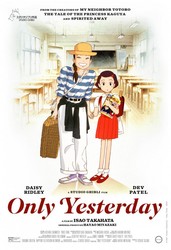


Summary:It’s 1982, and Taeko is 27 years old, unmarried, and has lived her whole life in Tokyo. She decides to visit her relatives in the countryside, and as the train travels through the night, memories flood back of her younger years: the first immature stirrings of romance, the onset of puberty, and the frustrations of math and boys. At theIt’s 1982, and Taeko is 27 years old, unmarried, and has lived her whole life in Tokyo. She decides to visit her relatives in the countryside, and as the train travels through the night, memories flood back of her younger years: the first immature stirrings of romance, the onset of puberty, and the frustrations of math and boys. At the station she is met by young farmer Toshio, and the encounters with him begin to reconnect her to forgotten longings. In lyrical switches between the present and the past, Taeko contemplates the arc of her life, and wonders if she has been true to the dreams of her childhood self. [Gkids]…Expand
One of the most realistic and heartfelt animations I've seen. Only Yesterday is a lesser known Ghibli film, because it's director by Isao "The other guy" Takahata, whos works are often overlooked, as he has the weirder, less appealing, and less kid friendly films (See, "Pom Poko" andOne of the most realistic and heartfelt animations I've seen. Only Yesterday is a lesser known Ghibli film, because it's director by Isao "The other guy" Takahata, whos works are often overlooked, as he has the weirder, less appealing, and less kid friendly films (See, "Pom Poko" and "Princess Kaguya"). As a director or film maker, excluding his use of Ghibli as a studio, I'd say he is one of the greatest Japanese directors of all time.
Only Yesterday is a very simple movie about a girl moving her life to the country, assimilating to farming, and finding love. It's slow, realistic, and showcases the ups and downs in life, and it flashes back consistently through the main character's childhood.
The movie tone is very bittersweet, and for an animation, feels more real than most live action romance films from Asia that I've seen.
This movie is not for everyone, none of Takahata's films are really, but it's an outstanding film regardless. Oh, and watch Pom Poko if you haven't yet, it's awesome.…Expand
Such beautiful and moving films. Easily one of Ghibli's best and most mature works. An introspective exploration of childhood memories and their role in shaping life as an adult, like most Ghibli movies, it's a movie about growing up, told in a way that makes the viewer reflect on their ownSuch beautiful and moving films. Easily one of Ghibli's best and most mature works. An introspective exploration of childhood memories and their role in shaping life as an adult, like most Ghibli movies, it's a movie about growing up, told in a way that makes the viewer reflect on their own childhood and realize how even the smallest things can make a big impact in the future, as well as how something seemingly hugely important may not really affect you in any way. Life is strange that way.
Most underrated and insanely nostalgic Ghibli masterpiece, it was a real beauty watching all the memories of past perfectly conected with beautiful plot. Isao Takahata truly is master of realism and that what makes his films feel so unique despite them being animated.
This movie has beautiful animation and a even more beautiful story. If you want to feel good, this is the movie for you. The characters are lovable and the storyline flows very smoothly.
very good movie
the animation is great the art style the story telling everything is just so good
watch this movie
give it a go its certainly worth checking out
It's already March 2016 and this qualifies for best 2016 film. If it only feels just like yesterday back in 1991 for Japan, then I would claim this to be the best Japanese film in 1991.
This review contains spoilers, click expand to view.
While there were many interesting moments in this film, its ending was particularly dissatisfying from a feminist perspective. On a positive note, the scripting for children and teens felt very naturalistic, and the countryside art was very appealing. The portrayal of the harm done by sex-divided puberty education was a notable high point of the film, though the lack of criticism towards the teachers and system that led to the boys' stigmatisation of periods and harassment of the girls was frustrating.
Likewise, the moments of pure sexism that are left to go unchallenged could have been a compelling tacit damnation of patriarchal society and the misogyny it generates. (Of particular note is the scene where two young women discuss their fathers hitting them without any implication that it's wrong, suggesting this kind of domestic violence is fully normalised in their lives.) However, by having the protagonist give up on her career at the end, and choosing to become the wife of a farmer rather than an independent farmer or farmhand, it seems that the movie chooses to resolve the tensions of her desire for personal fulfilment vs societal expectations by simply forcing her to conform and take on the socially accepted role of 'wife' instead of meaningfully engaging with any other concepts of female agency.…Expand