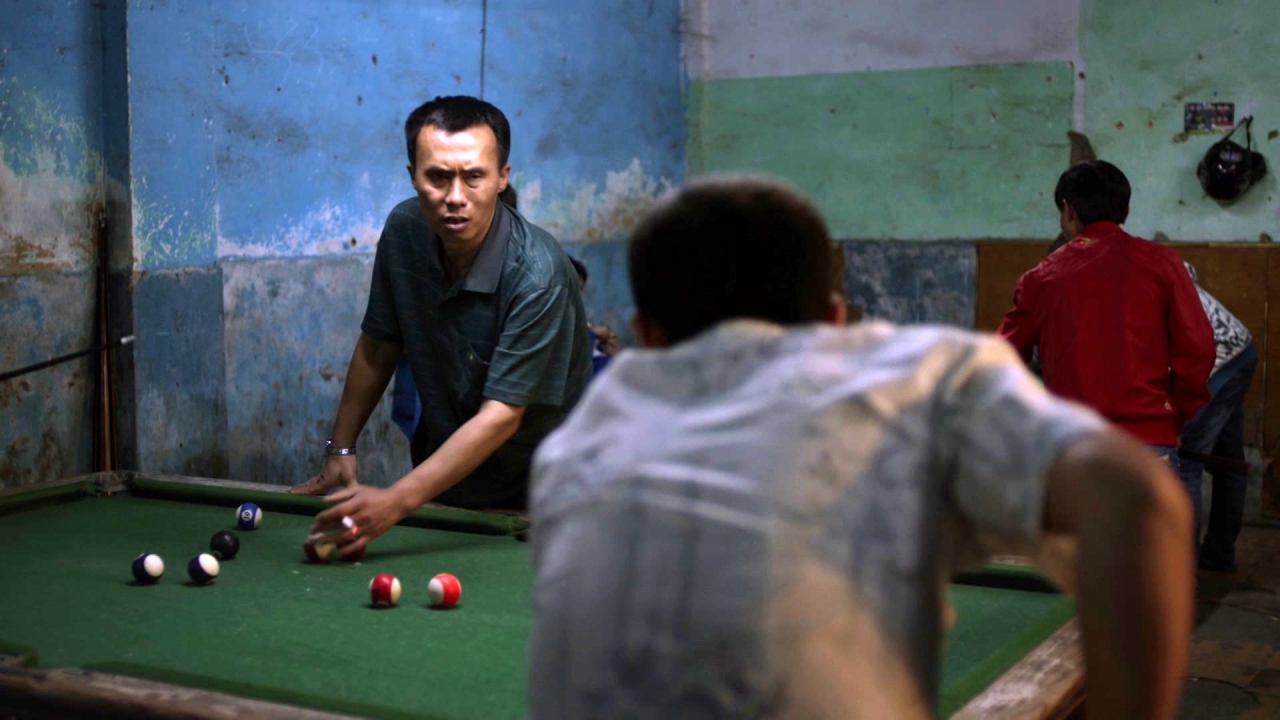



Summary:In a small clinic in the rain-drenched city of Kaili, two preoccupied doctors live ghost-like lives. One of them, Chen, decides to fulfill his dead mother’s wish and sets off on a train journey to look for his brother’s abandoned child. His partner in the clinic, a lonely old lady, asks Chen to find her old lover, and give him an oldIn a small clinic in the rain-drenched city of Kaili, two preoccupied doctors live ghost-like lives. One of them, Chen, decides to fulfill his dead mother’s wish and sets off on a train journey to look for his brother’s abandoned child. His partner in the clinic, a lonely old lady, asks Chen to find her old lover, and give him an old photograph, a shirt and a music cassette. But on the way, Chen passes a mysterious town called Dangmai, where time is not linear and people’s lives complement each other. Here, Chen experiences the past, present and future. It’s unclear whether this world is the doctor’s dream, or the other way around. [Grasshopper Film]…Expand
Kaili Blues is a film that impresses much more for its visual level than for its plot. And although for me both things are very important in evaluating the film as a whole, I am able to recognize that even though it will be a film that will not get a perfect rating from me, the intention ofKaili Blues is a film that impresses much more for its visual level than for its plot. And although for me both things are very important in evaluating the film as a whole, I am able to recognize that even though it will be a film that will not get a perfect rating from me, the intention of its director is perfectly understood.
You have to pay attention and appreciate the details, especially the technical craftsmanship. It's a film that rewards but only a certain type of viewer.…Expand
“Kaili Blues”, a rebut film directed by Gan Bi who hadn’t been heard before by most film critics or audience. The Chinese name of this film “Lu bian ye can” originated from Strugatsky Brothers’ “Roadside Picnic” which was rearranged into “Stalker” by Andrei Tarkovsky. In “Kaili Blues”,“Kaili Blues”, a rebut film directed by Gan Bi who hadn’t been heard before by most film critics or audience. The Chinese name of this film “Lu bian ye can” originated from Strugatsky Brothers’ “Roadside Picnic” which was rearranged into “Stalker” by Andrei Tarkovsky. In “Kaili Blues”, elements of poem, time and long-take can all find their origins in Tarkovsky’s work. However, Gan Bi doesn’t stop at just making a film that pays homage to that Russian master. He granted this film his own style, own film language and own details.
Gan Bi chooses Gui Zhou---a South Eastern province covered by endless hills and mystic forests as the place of story in this film. This place is isolated, impoverished and distant at now. It was the same in the past and would be continued to remain in this situation. This is a place where no story could be told at all but at the same time, everyone has one’s story to tell. Its mystery along with unpredictable beauty were shown in every way under Gan Bi’s shots.
The first way is through the people living there for all their lives. Chen Shen, a doctor in Kaili clinic who has an inglorious past with local gang leader Monk but suddenly ended after he was caught into prison because of a fight. Through several fragmented scenes, people around him came into the story: Old Doctor in the clinic, Chen Shen’s brother Crazy Face, Crazy Face’s little son Weiwei as well as other native residents in Kaili. These fictive characters consist a picture of mystic region in China where everything can happen but always slips quickly without noticing by any one. Monk’s son was buried alive and chopped off one hands by Monk’s enemies; Crazy Face even intends to sell his son for money to gamble and drink but stopped by Monk. The film narrates these unusual events in a casual tone, reflecting reality which seems so ironical for audience to believe.
The second way is through the story. Gan Bi creates a story with his own experience in Gui Zhou, in Kaili (It’s a real town). Films come from reality but detached as far as it can from that. Chen Shen’s journey from Kaili to Zhen Yuan occupies most part of the story---from reality to illusion, from imagination back to life. His film language shows this story in the most dazzling way like what Tarkovsky did in “Stalker” while the story, in return, rises beyond the language and becomes a mystery itself. The climax of this story occurs in Dang Mai where time goes forward and back freely as Chen Shen tried to get to Zhen Yuan: There was a young man riding motorcycle who named also Weiwei and talked about “wild men” as Crazy Face’s son did before; a beautiful woman who owns a local hair salon looked just like his old lover; several Miaos appearing many times in his dream played reed-pipe wind instruments there. Zhen Yuan, Kaili and Dang Mai, these three places represent past, present and future in this story, forming a magical trinity in this isolated paradise.
The last way is symbols Gan Bi uses throughout his film. The clock, serving as one of the most frequently occurred symbol, created the background of time. From the beginning, the child Weiwei draw a clock on the wall and then he was taken by a mystic man who had numerous clocks in his house. Even on the journey to Zhen Yuan, Chen Shen saw more than few times clock around him, symbolizing time moving swiftly while no pattern could be traced. Train, another important symbol in this story, appears as an impetus, carrying Chen moving from places to places, past to future, future to present. Dang Mai, a mystic town, arouses audience’s curiosity but reveals unforgettable truth among this South Eastern Chinese landscape. The last forty-minute long take filming this “mystical paradise” is discussed enthusiastically by most of audience as well as film critics. Nevertheless, this is just a technique which itself of no great significance but carries the soul of this film to an apex.
There are so many Andrei Tarkovsky’s shadows revealing in “Kaili Blues” but they are not touching the soul. This is Gan Bi’s movie. His own movie showing a mystical but tragic story in distant South Eastern China. With Poem, with time, “Everything that can’t be turned, can be turned.”…Expand