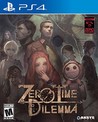
It's almost inconceivable to me that this was written and directed by the same person who did the last two games. He must have been in a completely different state of mind or the new studio pushed him down a different path.
I like good writing, but everyone's understanding of what "good" is is different, so let me rephrase by saying that I like intelligently written stories with noIt's almost inconceivable to me that this was written and directed by the same person who did the last two games. He must have been in a completely different state of mind or the new studio pushed him down a different path.
I like good writing, but everyone's understanding of what "good" is is different, so let me rephrase by saying that I like intelligently written stories with no major plot holes or inconsistencies. This is coming from a 40-year old who studies particle physics and astrophysics in his spare time.
The prior two games have some of the best writing I've ever experienced. Even though they were overly-complex to almost unbelievable levels, their plots remained solid and intelligent. However, this game is like a fan fiction that packs in as many references to the previous games as possible. By doing so, it fails to make its own compelling story with a solid plot.
Without spoiling anything, here's what it does poorly:
- Returning characters. There's too many in this game. Considering that the previous game happens in the future, this is a bad thing. And the game makes up far-fetched reasons as to why these characters remember what they do, while also making the characters act very differently than you'd expect.
- Unreasonable blood lust. People to go into murderous rampages. Even established characters who we know are highly intelligent. They always had a good reason in the previous game, but not this one.
- The villan's motivations are very weak and overly complex for no reason. There's plenty of ways he/she could have achieved his/her goals without doing what was done. There's also major conflicts in relation to the villain, timeline, and established lore in the previous game.
- Everyone has special powers. There's even new special powers that didn't exist before. There's no new science to back this up. It just magically happens. I miss the established scientific theory that was intertwined within the story for the last games.
- No worldbuilding. In the last game, you learned more about the world and your dilemma through the puzzles, documents, and character interactions. Each new piece was a profound twist that you didn't see coming, which made complete sense once it was revealed. In this new installment, the puzzles are completely separate from the story. There's no worthwhile world-building, and each new twist just adds to the plot holes.
- Fragmented storytelling. Shortly after starting the game, you instantly have access to dozens of different story lines that take place in different timelines. You'll have no idea whether the fragment you're choosing is in the same timeline, at the end of the game, or the beginning of the game. This makes most of your big decisions meaningless, since you don't see the direct effect of your decisions by continuing in that story line - you have no idea where you'll end up.
- Decisions have no impact. In the previous game, I dreaded choosing to betray someone because I knew that I had to face that person or the full group immediately after I made my choice. There's no such thing in this game. Your decisions are done privately. You don't interact with the people who are affected by them. And your own team members don't care too much if you make a bad decision.
- No profound and touching moments. You know that one character's scene in the last game. Yeah, you know the one. Nothing like that here. Well, they tried to emulate something like that, but it fell flat due to plot holes.
- Power of friendship. There are sections in certain games or kids shows where everyone works together through "the power of friendship," and they point out to the bad guy that they have this "power of friendship" so they can't lose? Yeah, that happens here.
I could go on, but I don't have time to deconstruct each plot point, and that would involve spoilers. In summary, the writing is horrid. There are a few good moments, but they're normally completely invalidated by later plot holes.
The game is shorter than its predecessor by at least 10 hours. That was a good thing for me, at least.
The puzzles are good, but there's less of them than there was in the last game. And it recycles puzzles a few times. It used the jigsaw-type puzzle and cube-rotating puzzle about 3 times each. After you do this once, the others are incredibly easy.
You'll spend the last ~4 hours in cut scenes. There is no final master puzzle room like there was in the previous game.
To conclude, If you were expecting intelligent storytelling that matched the previous game, you won't find it here. If that's important to you, I'd skip this game and make up your own conclusion to the cliffhanger to the previous game. It will likely be better than what happened here.… Expand